
Infosys founder N.R. Narayana Murthy has reignited a heated national conversation by once again advocating for an Indian work culture modeled on China’s infamous ‘996 rule’—9 am to 9 pm, 6 days a week—amounting to 72 hours on the job. In a new interview with Republic TV, Murthy cited his own team’s experiences in China, suggesting that such arduous routines underpin China’s dramatic economic progress and could be the key for India’s youth to drive faster national growth.
Narayana Murthy doubled down on previous statements, declaring, “No country has ever come up without hard work,” and holding up Prime Minister Narendra Modi’s reputed 100-hour work week as an example of individual commitment to nation-building. He contended that nations and communities can only “get a life” after achieving economic upliftment through hard, sustained effort—a perspective that quickly drew praise from some industrialists but also provoked passionate public resistance.
The China ‘996’ Model
- The ‘996 work culture’ (9 am–9 pm, 6 days a week) drove expansion in Chinese tech sectors but has been widely criticized for causing chronic burnout, mental health crises, and even premature deaths—so much so that it was officially declared illegal by Chinese authorities in 2021.
- In China, the backlash has sparked movements like “lying flat,” with young workers rejecting hyper-exploitative schedules for mental well-being and balance.
- Critics call 996 “modern slavery” and point to World Health Organization data linking such overwork to over 745,000 deaths annually worldwide.
Read this: L&T Chairman Clarifies 90-Hour Workweek Claims, Says “My Wife Was Upset”
Public Reaction on Narayana Murthy’s Claim: Viral Dissent and Work-Life Balance
Murthy’s latest remarks have unleashed a wave of social media pushback across platforms, with employees, professionals, and even startup founders making their voices heard.
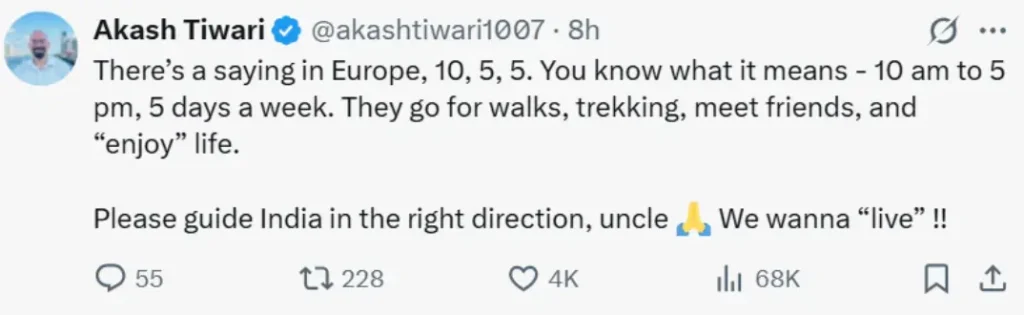
- “We wanna live!” Akash Tiwari’s viral post invoked the European “10-5-5” work culture (10 am to 5 pm, five days a week), highlighting Europeans’ ability to value life outside work and urging Indian leaders to prioritize a “life worth living”.
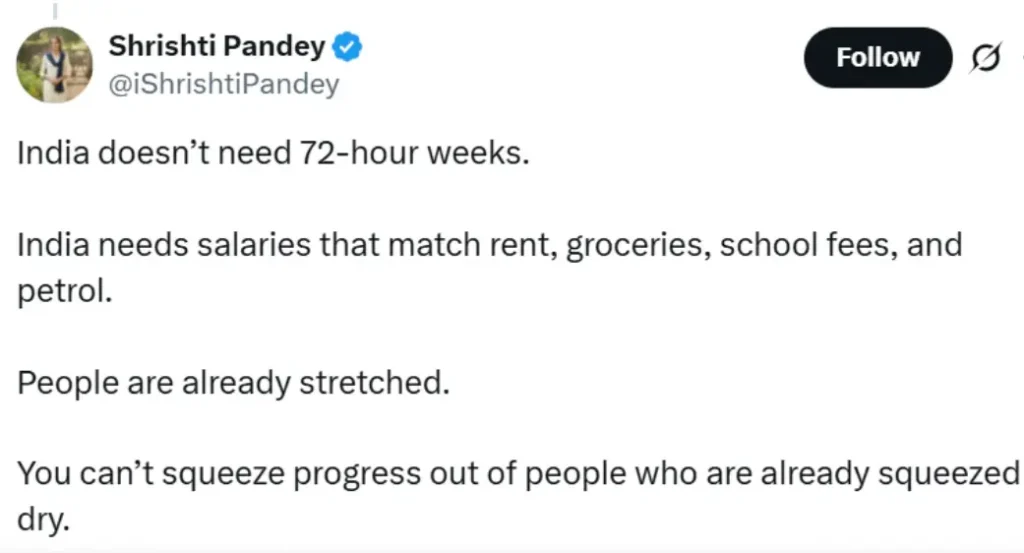
- Pressure on Indian Salaries: Shrishti Pandey, among many commenters, argued, “India doesn’t need 72-hour weeks. India needs salaries that match rent, groceries, school fees, and petrol… You can’t squeeze progress out of people who are already squeezed dry.”.
- Time Lost to Traffic: Others sarcastically noted the 12-hour days many urban Indians already lose to commute congestion, equating “work time” with “traffic time”.

- Global Standards: Professionals such as Dheeraj Razdan pointed out that such demands are only plausible if India also adopts China-level employee benefits and paid leave, reinforcing an “outcome over hours” work ethic and a preference for capping weeks at 40 hours.