
Amazon Now is Amazon India’s instant‑delivery layer for daily essentials, groceries and a limited general‑merchandise catalogue. It launched quietly in Bengaluru in late 2024 as a 10–15 minute delivery pilot and expanded to Delhi and Mumbai ahead of the 2025 festive season.
Since then, traction has been strong enough for Leading e-commerce giant to hit the accelerator. The company:
- Went from about 100 micro‑fulfilment centres (MFCs) before the 2025 festive period to an estimated 250+ today.
- Is now opening two new MFCs a day across Bengaluru, Delhi and Mumbai, and expects to end the year with well over 300 centres.
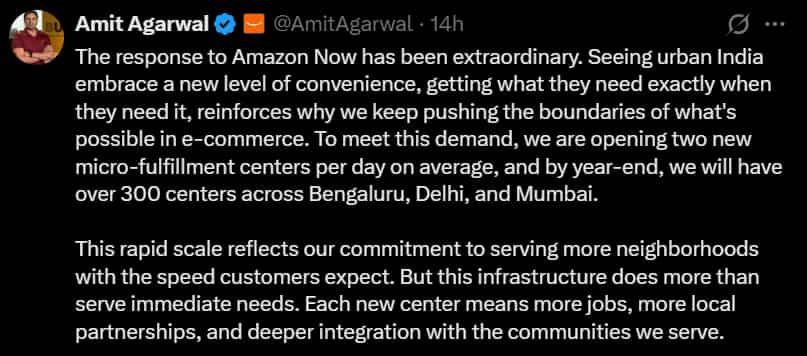
In a post on X, SVP Amit Agarwal said the response to Now has been “extraordinary,” with urban India rapidly embracing faster, need-based delivery.
To meet this rising demand, We are now opening two new micro-fulfillment centers every day, on average. By the end of the year, the company expects to have over 300 such centers across Bengaluru, Delhi, and Mumbai.
Earlier, Country manager Samir Kumar said Prime members “triple their shopping frequency” once they start using Amazon Now, suggesting that the service is replacing many small kirana or supermarket trips with multiple micro‑orders each week. Amazon Now currently offers:
- Essentials and a full grocery range in minutes.
- Around 40,000 SKUs deliverable within a few hours.
- Over 1 million products available for same‑day delivery and 4 million more for next‑day in the same cities, by blending MFCs with existing fulfilment centres.
Amazon’s strategy to compete with Blinkit, Zepto and Instamart
It is entering a market already dominated by Blinkit (backed by Eternal Ltd.), Swiggy Instamart and Zepto, all of which have spent years building dense dark‑store networks and consumer habit. Analysts estimate:
- Blinkit now has 50%+ market share in quick commerce GMV.
- Zepto and Instamart fight for the No. 2 slot, with BigBasket’s BB Now, Flipkart’s Minutes and Amazon Now splitting the remaining share.
Against this backdrop, Amazon’s playbook has three big levers:
- Network density via micro‑fulfilment centres
Their each MFC is a compact, highly automated “dark store” located inside or very close to residential clusters. It uses AI‑driven systems to predict hyperlocal demand and optimise which SKUs each MFC should stock, so that riders can hit 10‑minute SLA without bloating inventory. Opening two such centres a day is Amazon’s way of catching up on physical density while leaning on its existing logistics backbone. - Blending ultra‑fast with full‑stack ecommerce
Unlike pure quick‑commerce apps, Amazon can cross‑sell the entire Amazon.in catalogue. The same user who orders milk and bread in 10 minutes can also buy electronics, fashion or home products for same‑day or next‑day delivery. That helps:- Lift overall Prime engagement.
- Spread logistics and customer‑acquisition cost across more categories and higher‑ticket orders.
- Leveraging Prime and ecosystem stickiness
Prime subscribers are already habituated to Amazon for streaming, large ecommerce orders and payments. Amazon Now plugs into that stack as another Prime‑linked benefit, reducing the need to re‑acquire users in a new app. Amazon reports that once ultra‑fast delivery goes live in a neighbourhood, Prime member purchase frequency for daily essentials roughly triples.
Strategically, Amazon isn’t trying to win purely on “10 minutes or free” gimmicks. Its pitch is “fastest where it matters, widest selection overall”—an attempt to shift the battle from raw speed to a mix of speed, selection and reliability.
Where quick commerce in India stands now
India’s quick‑commerce GMV hit about $6–7 billion in 2024 and is expected to grow at ~40% CAGR through 2030. Blinkit, Zepto and Instamart together run thousands of dark stores across 100+ cities, and each is chasing or preparing public‑market events:
- Blinkit’s valuation has jumped to an estimated $15 billion inside Eternal.
- Zepto, valued around $6 billion, is eyeing a listing in 2026.
- Swiggy is targeting large raises ahead of its own IPO, with Instamart contributing a big slice of its overall GMV.
At the same time, the shake‑out has begun: Dunzo has effectively shut operations, and only capital‑rich or strategically backed players (Blinkit–Eternal, Zepto, Instamart–Swiggy, BB Now–Tata, Flipkart Minutes–Walmart, Amazon Now) are left in the top tier. Profitability remains a work‑in‑progress, but unit economics have improved as average order values climb, delivery fees normalise, and dark‑store productivity rises.
In this context, Amazon Now’s accelerated rollout is less about being first and more about making sure Amazon doesn’t get structurally locked out of a habit‑forming channel in urban India. By stitching together micro‑fulfilment density, Prime lock‑in and its broad marketplace, Amazon is betting that ultra‑fast grocery is not an isolated category but the new front door into its entire Indian ecommerce ecosystem.
Read this: Amazon Layoffs 75% Indian Workforce? Viral Reddit Post Exposes Tense Environment Inside Office

